Network Control Plane
Routing Across the Internet
Wednesday, March 18, 2026
Lesson Objectives
- Autonomous System and its role in network routing; understand boundaries and interior routing
- Intra-AS: OSPF’s use of LSAs for scalable routing
- Inter-AS: BGP as the primary protocol; exchanging routing information between different AS
- Different types of BGP peering relationships, eBGP and iBGP, and their significance in inter-AS communication.
Textbook Readings
- \(5.3\) Intra-AS Routing in the Internet: OSPF (Open Shortest Path First)
- \(5.4\) Routing Among the ISPs: BGP
Recap
Link State Routing
- Routers flood LSAs
- Global knowledge of network topology
- Dijkstra’s algorithm to compute shortest paths
Distance Vector
- Share information with neighbors only
- Iterative updates!
- Loops possible until convergence
Why Autonomous Systems?
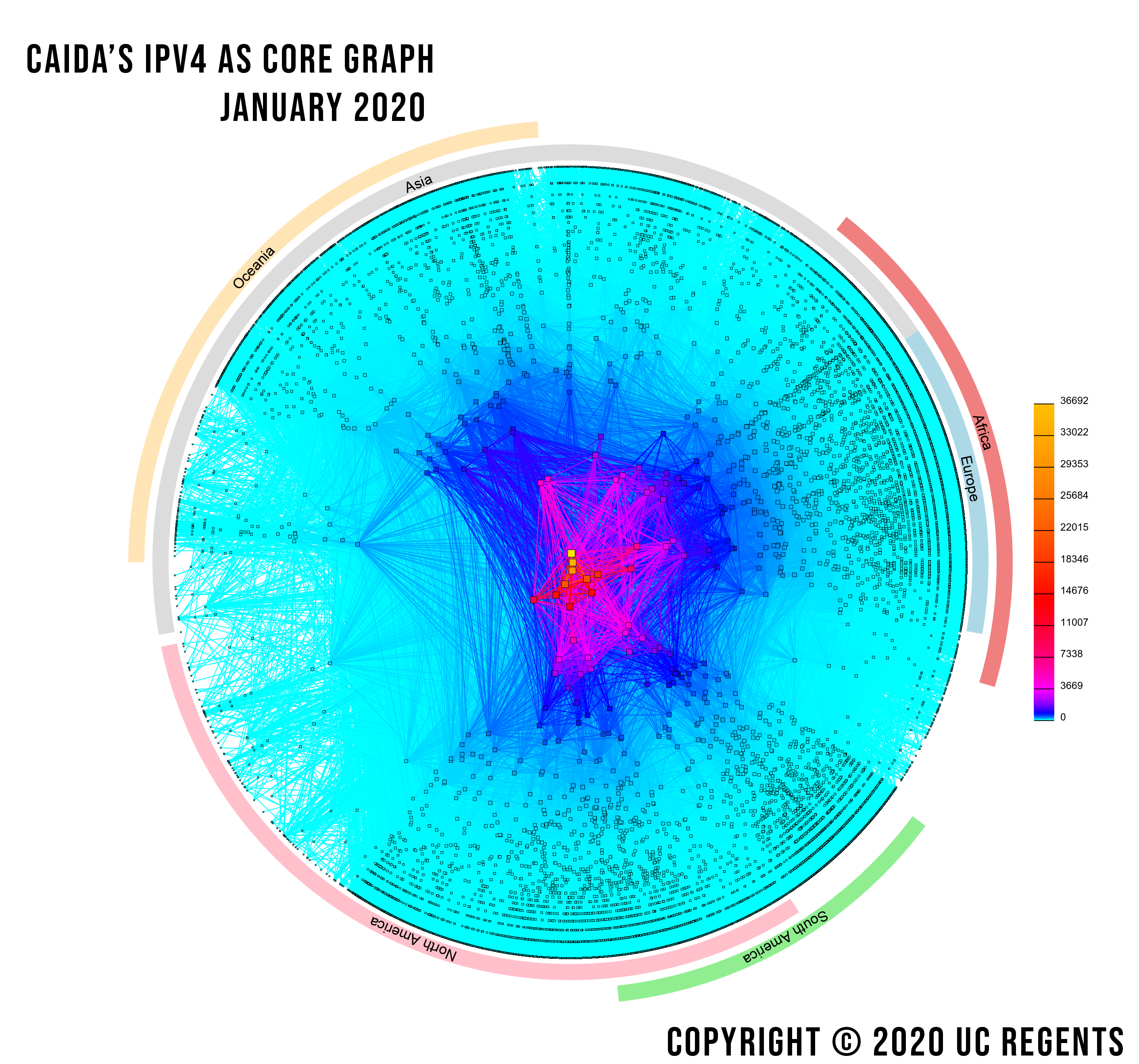
- How big is the Internet? 🌍
- What if every router shared full routing state? 🤯
- Could we group certain routers?
- And then share only reachability between groups?
- Autonomous Systems (AS) to the rescue!
What is an AS?
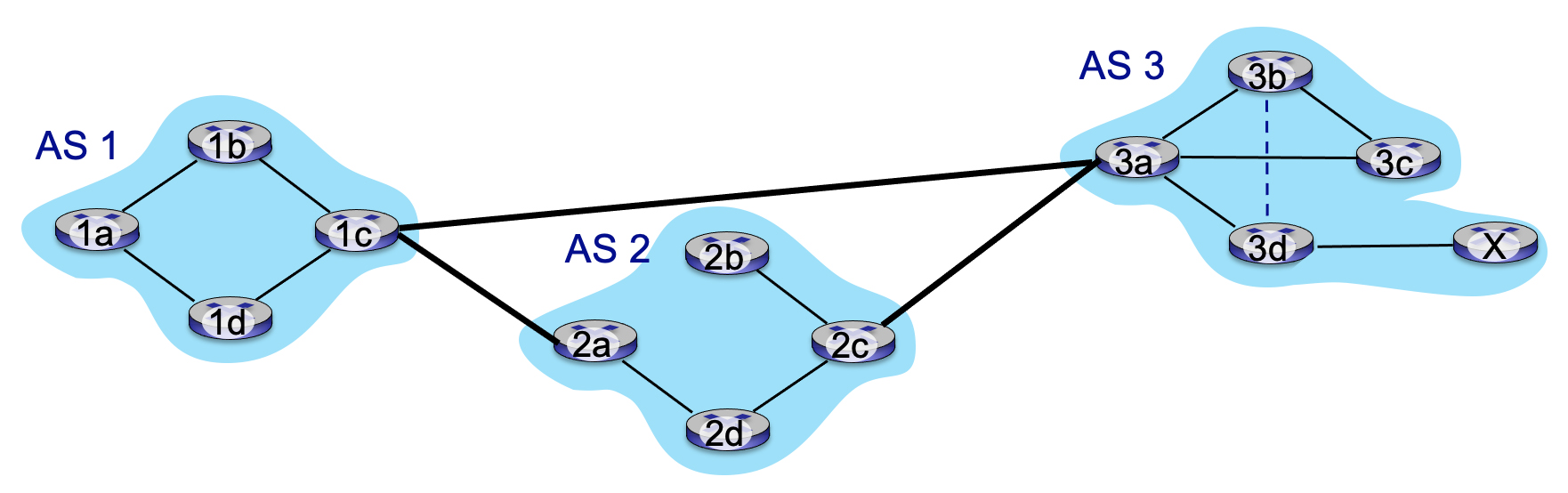
- A network (or set) under single administrative control 🏢
- Clear borders at edge routers; has an AS number (ASN)
- Goals: scalability, policy independence, fault containment
- What is your current AS?
- Which AS is the biggest? How many addresses does it cover?
Intra-AS vs Inter-AS Responsibilities
- Intra-AS: pick efficient internal paths; optimize performance/availability
- Inter-AS: exchange reachability & enforce policy/economics 💸
- Different metrics, objectives, and protocols by design
Intra-AS Routing Protocols
Intra-AS Protocols
- RIP (Distance Vector), OSPF (Link State), IS-IS (similar LS)
- EIGRP (DV-based; historically proprietary)
- OSPF is highly scalable, feature-rich
OSPF Core Mechanics
- Flood link-state info (LSAs) to build a shared topology map
- Run Dijkstra to compute shortest paths → forwarding table
- Supports message authentication 🔐
OSPF Hierarchy & Areas
- Area 0 (backbone) connects all other areas
- Internal routers: entirely inside one area
- ABR: between areas; summarizes & advertises to backbone
- ASBR: connects to other ASes; injects external routes
- Flooding stays within an area; summaries cross areas
Inter-AS Routing Protocols
What protocols exist?
- EGP (Exterior Gateway Protocol)
- IDRP (Inter-Domain Routing Protocol)
- NIRA (Next Internet Routing Architecture)
- RIFT (Routing in Fat Trees)
- LISP (Locator/ID Separation Protocol)
- BGP (Border Gateway Protocol)
Why BGP?
- Path-vector: “Here I am, who I can reach, and how” 🧭
- Prioritizes policy & business relationships over pure performance
- The only inter-AS routing protocol in practice
BGP Basics
- Peers exchange reachability info (prefixes) + attributes
- Uses TCP (port 179) for reliable transport
![]()
Textbook 5.2
eBGP
- Peers between different autonomous systems
- Only advertises the single best path per prefix to neighbors
- Path-vector: advertises prefixes (NLRI) with attributes (AS-PATH, NEXT-HOP)
- Loop prevention: reject routes that contain your own ASN in AS-PATH
- Policy-driven: import/export filters decide what to learn/advertise; avoid unintended transit
- Edge learns from neighbors via eBGP, then distributes internally via iBGP
iBGP
- distribute external routes internally
- spread exits - reachability!
- does not change AS-PATH
What exactly is being advertised?
- Prefix (NLRI): destination network (CIDR)
- AS-PATH: sequence of ASNs traversed to reach the prefix
- NEXT-HOP: IP of the border router to reach the next AS
![]()
Textbook 5.2
Populating Forwarding Tables: Hot Potato
- Exit the AS at the closest egress router 🥔🔥
- Minimizes internal cost; may increase total path length
- Chosen via attribute ordering + local policy (e.g., LOCAL_PREF, AS-PATH)
![]()
Textbook 5.2
Intra-AS vs Inter-AS
- Policy: core in inter-AS; limited inside an AS
- Scale: OSPF hierarchy within AS; BGP summarization between ASes
- Performance: intra-AS optimizes metrics; inter-AS prioritizes policy
OSPF LSAs always flood across the entire AS (all areas).
- True
- False
Which statement about iBGP is correct?
- It carries routes between different ASes
- It modifies AS-PATH to add the local AS
- It distributes external reachability within an AS
- It replaces OSPF for intra-AS forwarding
The main motivation for “hot potato” routing is to:
- Minimize end-to-end Internet latency
- Minimize internal AS cost to the nearest exit
- Satisfy legal requirements
- Evenly balance load across all links
Match the protocol model:
- OSPF — distance vector; BGP — link state
- OSPF — link state; BGP — path vector
- OSPF — flooding forbidden; BGP — flooding required
- OSPF — policy-based; BGP — performance-based
Why might an AS choose not to advertise a learned route to a neighbor?
- It breaks the TCP three-way handshake
- Privacy/trust/policy concerns or to avoid becoming transit
- iBGP forbids external advertisement
- OSPF area mismatch
Which BGP attribute tells a router where to send packets to reach the next AS?
- AS-PATH
- NEXT-HOP
- LOCAL_PREF
- MED
Key Takeaways
- The Internet scales by grouping routers into ASes with local control
- OSPF (intra-AS): link-state + Dijkstra; LSAs scoped by area; ABR/ASBR roles; Area 0 backbone
- BGP (inter-AS): path-vector + policy; eBGP across ASes, iBGP inside an AS
- Key attributes: AS-PATH and NEXT-HOP; selective advertisement is normal
- Hot potato: exit at nearest egress to minimize internal cost—even if globally longer
- What went wrong?
- Was it accidental or malicious?
- What was the intended effect?
- What was the impact? Who suffered?
- Who benefited?